Friday, June 7, 2013

MTN Tackles Crisis in Education

THE growing crisis in the education sector has caught the attention of MTN Nigeria and has consequently urged its staff to join hands to tackle the challenges.
In response to the challenges, staff of the telecommunication
L-R: Company Secretary, MTN Nigeria, Mrs. Ukpanah Utoh, Principal of  Lanre Awolokun Senior High School, Gbagada, Mrs. Adams Ibironke Abiodun, Executive Secretary, MTN Foundation, Ms. Nonny Ugboma and Project Manager, MTN 21 Days of Y’ello Care, 2013, Mr. Omojola Felix during the donation of a digital library to the school as part of the activities of 21 Days of Y’ello Care, the company’s annual staff volunteerism programme, Lagos.
s company came out in large numbers on Monday, during the 21 Days of Y’ello Care to buy educational books from Evans Publishers Limited, which will be donated to schools across the country to mark the celebration, with the theme: Investing in Education for All.
Chairman of MTN Nigeria, Dr. Pascal Dozie who flagged-off this year’s edition described the 21 Days of Y’ello Care as the corporate social investment initiative of the company saying that this year, MTN together with its staff across the country will be shaping Nigeria’s future through education.
The reason, according to him is that the MTN family understands and recognises the pivotal role that education plays in the development of the any nation adding that “given the current state of affairs, I believe that the private sector, civil society, parents and indeed everyone have a collective role to play in ensuring that our children receive quality education.”
Dozie disclosed that MTN is motivated to urge its staff to join in contributing to the 21 Days of Y’ello Care because the quality of learning delivery in the country continues to deteriorate from primary to tertiary levels saying that there is lack of sufficient funds to cover the education of the nation’s growing population.
He stated critical areas of science and technology are poorly funded stressing, “This leaves our children ill-prepared for the technology-based, digitally-driven future that awaits them.”
Also speaking at the event, chief executive officer of MTN, Brett Goschen said that digital learning will make up the core of this year’s Y’ello Care campaign adding that it is the corporate vision of MTN to lead the delivery of a bold new digital world,”we intend to take this to the classroom.”
According to him, through the studyplace project of the MTN, nine e-libraries across Lagos, Abuja and Port Harcourt to encourage healthy study habits, promote a reading culture and increase access to digital technology amongst Nigerian students.

He added that the other projects that will future in the one-month campaign are the Book Fair and the Teachme Reachme, where MTN staff will go to schools across the country to impact knowledge on students as well as provide career counselling.

International Breweries Sales Revenue Hit N17b

INTERNATIONAL Breweries sales reached a high figure N17.39 billion at the closed its 2012/13 financial year with an increased market share in a slowly growing breweries industry.
The company achieved an exceptional growth of 75.5 per cent  in sales revenue to, a growth rate that is unmatched in the industry in the year.
The high growth in sales revenue is against a slow down in sales among the industry leaders at 11.7 per cent  for Nigerian Breweries in 2012 and a flat growth of 2.1 per cent  for Guinness Nigeria.
This is an indication that International Breweries regained significant market share during the financial year ended March 31 2013.
The company’s 15-month account shows that the strong growth in sales revenue is accompanied by cost moderation, resulting in a big lift in profit performance. The ability to keep cost of sales relatively low was a major favourable development in the company in the year.
Cost of goods sold grew at 42.8 per cent  to N9.69 billion compared to 75.5 per cent  growth in sales revenue. The cost per naira of sales therefore went down from 68 kobo in 2011 to 56 kobo in 2013.
The company raised gross profit margin from 32 per cent  to 44 per cent  over the review period.
Another major cost saving came from moderation in marketing and promotion expenses. This means the company has used a significantly reduced cost to generate a naira of sales revenue in the year.
The company also has not been hurt by interest charges that are eroding profit margins of companies generally. Instead, it reversed its position from net interest charges of N79.4 million in 2011 to a net interest income of N18.4 million in 2013
ncreased borrowing witnessed in the course of the year could however change the story in the current financial year.
One major expense line remained out of control during the year and this is administrative cost.
The cost item had tripled at N3.31 billion by the end of the third quarter and constitutes a major part of the N4.29 billion distribution/administrative expenses at full year. Administrative expenses therefore claimed an increased share of sales revenue at about 25% in 2013 compared to 10% in the preceding year.
The high growth in sales revenue and cost moderation in other key expense lines more than compensated for the increase in administrative cost. After tax profit therefore soared from only N199 million in 2011 to N2.51 billion at the end of the 15-month account in March 2013.
The company converted 14.4 per cent  of its sales revenue into after tax profit in 2013, advancing from only 2.0 per cent  in the preceding year. This is a move against the industry trend.
Nigerian Breweries recorded a decline in net profit margin from 18 per cent  in 2011 to 15.1 per cent  in 2012. Net profit margin of Guinness declined from 12.1 per cent  in 2011 to 11.6 per cent  at the end of its financial year in June 2012. Its net profit margin went down further to 9.8 per cent  at the end of its 3rd quarter last March.
International Breweries earned 71 kobo per share in 2013, up from 9 kobo it earned in 2011. The company has proposed a cash dividend of 25 kobo per share or a bonus of 1 for 85. This is the first dividend that the company is offering to shareholders in the past five years.
The register of shareholders is scheduled to close on 19th July and payment is to be expected on 13th August 2013. This is a dividend pay-out of 35.2% per cent  and a dividend yield of about 1.0 per cent  . Net assets per share stood at N2.87 at the end the 2013 financial year.
Major developments in the company’s balance sheet during the year include a 48.8 per cent  rise in inventories and a leap of 186% per cent  in debtors and other receivables. This means the company employed a lot of trade credit inducements to achieve the strong growth in sales revenue. All the same there was a major improvement in cash balances, which advanced by more than 227 per cent  during the year.
There was also a drop of 46.5 per cent  in trade and other payables. The developments impacted adversely on the cash flow and the company had to resort to massive borrowings to keep the business running. Short-term borrowing advanced from only N136 million in 2011 to N2.42 billion at the end of the 2013 financial year.
Long-term borrowings also rose from N39.6 million to N3.79 billion over the same period. This seems to suggest that interest charges could rise considerably in the current financial year.
The company is expected to maintain relatively strong growth in sales revenue in the current financial year and favourable cost behavior is again likely to sustain profit growth. Further gain in profit margin isn’t likely however, as increased borrowing are expected to raise interest expenses. A continuing growth in profit is expected but the company needs to check the high growth in administrative cost. Dividend payment is expected to be sustained.


Intermarc Consulting Unveils Plan for 2013 Card, ATM Expo

Nigeria Minister of Communications Technology Omobola-Johnson
THE organisers of the yearly Card, ATM and Mobile Expo, Intermarc Consulting has said that this year’s edition is geared towards creating unique learning sessions where  shared services implementations across the world can share their learning points with Africa.
The organisers in a statement said that the theme for the 13th edition of the international conference and exhibition is "Shared Services: Optimising Payment Systems in Africa" saying that the Card, ATM & Mobile Expo 2013 will showcase innovation and new differentiated products, bring about new relationships, brainstorm strategies to increase your competitive advantage, forge lasting partnerships and reach new uncultivated segments. This three-day event will provide a special opportunity for networking and follow up on business leads.
According to the organisers, cards and e-payment have now taken centre stage in the economies of most African countries. Banks and other financial institutions are consistently looking for solutions and VAS for the benefits of the market, which is also maturing and coming to terms with the reality of modernisation with the benefit of security, speed and convenience.
It added that the focus across the continent is on how to leverage on infrastructure at reasonable cost so that the benefit can be passed to consumers who are forever complaining about high cost of transaction.
It further said that in order to maximise the potential benefits of e-payment, the concept of shared services has been adopted in most implementations in the United Kingdom, Asia and Europe.
It said: “We also see similar trends in South Africa. This concept is becoming more popular in the rest of Africa. The question however is, "How do stakeholders cooperate to compete?"
The statement said that a list of things participants should be looking forward to at this year's Card Expo includes its Conference, which will discover the latest and hottest trends in the card and epayment industry  adding that “our conferences focus on real and relevant issues facing the African market and have been designed to ensure you leave with the know-how to improve your business in 2013.
“The 13th edition of Card, ATM & Mobile Expo promises a superb learning experience where successful shared services implementations across the world can share their learning points with Africa.”
Concerning its International Exhibition, the statement said, “Over 50 exhibitors from all over the world will be here to show case their latest innovations, technologies and solutions at the exhibition and meet with target market in the card and e-payment industry.
It added that the tour of exhibition will avails participants the opportunity to meet key players’ face-to-face, gain valuable information and see demonstration of different e-Payment products.
While calling for sponsored, the statement said that the Sponsors Forum would offer the opportunity “to get your message across to your target audience and senior level decision makers responsible for shaping their organisation's investment strategy in the African e-payment market. The sessions will cover hot topics on e-banking, mobile payments, POS and ATMs.
The statement also said that the General Sessions offer free learning sessions where over 1000 participants (unbanked, under banked, merchants, etc.) would listen, ask questions and learn more about your products and services throughout the event.
Intermarc disclosed that speakers at the conference are seasoned industry experts in the card and e-payment industry who cut across the globe adding that they are set to deliver presentations designed to excite, inspire and engage.
Other attraction at the conference is a VIP Networking Cocktail that will bring together leading local and international figures in the payment industry to network in a relaxed environment. It is create a unique avenue to strengthen old and develop new key business relationships.

The organiser said that an e-Business Awards & Dinner, will also be held to  round off, to appreciate, honour companies and individuals in the industry that support the ideals of CardExpo Africa. 

ICT Education: British Council Challenges FG to Collaborate with Private Sector

THE huge potentials that are inherent in the large young population of Nigeria could only be the future of the country if government and the private sector collaborate to use ICT to drive education.
Country Representative of the British Council, Mr. David Higgs in an interview with journalist in Lagos, said that ICT education holds the key to the desired growth that will enable the country  to take its place in Africa.
According to him, to achieve its dream of getting its young large population educated, the government needs to collaborate with other development partners in the global.
Higgs who spoke after presenting a Digital Hubs of 20 PCs to Oregun Senior High School, Oregun,Lagos, Nigeria said that now is the time for Africans, and that Nigeria is the centre of activities in Africa.
He disclosed that the young population needs ICT to have access to good education saying that with the Digital Hubs, the students will be able to interact with their peers in other parts of the global.
Higgs stated that the PCs in the Digital Hubs are connected to the internet thereby giving the students access to information at the tip of their finger adding that with the facility the students will be able to connect to schools in other parts of the world and do their academic project with ease.
He stressed that  ICT gives power to access knowledge, other communities and groups of people adding that that is the real benefit of the ICT.
The project of connecting schools across the world with internet, which is called Badaliko is according to him,  been going on for three years in six countries saying that the project is also going on in other regions of the world under different names.
He disclosed that the project, which is also going on the United Kingdom is a self-interest project explaining that Britain also wants its kids to also be able to talk and interact with kids in other parts of the world.
Higgs added that the project is as beneficial to the UK youths as to youths in other parts of the world saying that the British Council has been involved in promoting education in Nigeria for 40 years.
He noted that over the years different ideas have emerged in the British Council education activities  saying that it has become clear that no one can do its job effectively without being connected to the internet.
He stated that kids are going to go to the university and graduate to work and such they need to understand how to use communication technology to do their work stressing that just as it is in the UK, the most important thing is producing young employable adult who work in all different kinds of field to build their country.
Higgs who has spent four years in the country stated that there is no need to panic about the abuse of the facility by some students saying that the facilities are not on open access to anybody at anytime.
According to him, the British Council has selected a group of teachers known as Digital Ambassadors who are trained as trainers to guide the teachers and the students in the use to avoid abuse.
He added that the reason for giving access to technology to young people is to train them to use it in a responsible way  noting that the early the kids are taught, the bad and good sides of technology the safer it is for them to use it to better their life.
On the cost of the project, he said that the project is a partnership with Microsoft adding that both invested $1 million each into it for the six countries concerned.
He also disclosed that the British Council and Microsoft are not the only organisation doing such project adding that there are other organisation that are making sure that technology gets into schools in the country.
He observed that school population in Africa is growing faster than the ability of government to provide teachers and other materials adding that 10 years from now the whole schools in Lagos are going to be wired up.


Wednesday, June 5, 2013

Airtel introduces Bid & Get Service

Airtel Nigeria has introduced a new package for its customers known as the Bid and Get.
The service is a direct reverse of the traditional concept of auction, where the highest bidder is declared a winner.
With Airtel Bid and Get, a customer whose bid is the lowest and unique automatically wins the bid for the advertised item for the day. The winner can purchase the item for N100 only irrespective of the retail price of the item.
To register for Airtel Bid and Get, customers are to send the word “BID’ to the short code 3210 free of charge, and thereafter participate in the bid by sending their bid amount to the 3210, at N10 for every bid SMS.
The customer whose bid is the lowest and is unique at the end of the bidding cycle is declared the successful bidder and would automatically be eligible to buy the product on offer for N100.
On receipt of SMS informing a participant of winning a particular bid auction, the successful bidder is to send the word “WIN” to “3211” and thereafter, would be presented with his winning at the nearest Airtel office.
Speaking on the latest innovation from Airtel, the Chief Operating Officer, Deepak Srivastava said being another product by the company, the rollout further confirms Airtel’s innovativeness and superior value propositions as it draws closer to becoming the most loved brand in the lives of Nigerians.
According to him, customers including those that have ported from other networks are in for good times as exotic items including top-of-the-range communication devices, house-hold electronic gadgets and other goodies on auction would be won by bidders across the country. 
He stated: “the uniqueness of the Bid and Get Service is that a fix amount of N100 is what a successful bidder pays for any item won, irrespective of the current retail price in the market. The distinction of this service yet again proves that as a company, we dig deeper into the ideas box to bring out impactful propositions that excites not just the customers including the youths, but the entire telecoms market.”

The Airtel Bid and Get auction service is open to both pre and post-paid customers and the first item on auction would be Iphone 5 and Ipad mini communication gadgets.

Thursday, January 31, 2013

MTN Nigeria Ready for Mobile Number Portability

Nigeria’s leading Information and Communications Technology (ICT) company, MTN has said that it is ready to implement Mobile Number Portability (MNP) in consonance with the policy of the industry regulator, the Nigerian Communications Commission (NCC). The NCC has recently announced plans to flag off Mobile Number Portability in the first quarter of this year.
 Speaking at an internal stakeholder forum recently, MTN CEO, Brett Goschen, said the company had been ramping up efforts to make MNP a reality for mobile phone users in Nigeria who are eager to join the country’s most expansive network.
 “We have made necessary investment in infrastructure and manpower and we are now finalising the process of making this project a reality,” said Goschen. “We are confident that when the NCC is ready to blow the whistle for the kick off of this project, we will be ready.”  
 Goschen disclosed that a series of tests had been carried out on the company’s systems and infrastructure, adding that more tests will be carried out in the days ahead to ensure that the project takes off without any hitch.
 “We are excited that customers who wish to join the network with the most coverage of Nigeria will now be able to do so without worrying about losing their mobile numbers. As you know, we have made far more investment in our network than any other operator in Nigeria has done, with the result that  we are today the clear leader with effective network coverage of more than 85 percent of Nigeria’s land mass and population.
 “We have nearly 100 percent coverage of most major highways in Nigeria and we are gradually moving towards the final laps of a massive, nationwide network modernisation and swap-out exercise that is bound to give the network unequalled capacity and much improved quality of service. We have no doubt in our minds that mobile phone users on other networks in Nigeria will be eager to port into MTN to avail themselves of these and other benefits they can only find on the MTN network,” he said.  
 Apart from its massive investment in its core services, MTN remains the only operator that has created a Corporate Social Responsibility (CSR) vehicle, MTN Foundation, to implement life-impacting social projects across the length and breadth of Nigeria, Goshen said.
 He added that the company through MTNF had invested over N5 billion in such social projects which have directly and indirectly impacted millions of lives in the areas of health, education and economic empowerment.
 He affirmed the company’s commitment to continue to seek for ways of adding value to the lives of Nigerians both through the company’s core services and corporate social investment initiatives.

NCC Pegs SMS rate at N3

The Nigerian Communications Commission has set a price cap of N4.00 (Four Naira per message) for all domestic Off-Net Short Messaging Service with effect from February 5, 2013.
The directive to this effect, which was communicated to the operators since January 3, 2013, said the Commission will not place a price cap on International SMS at this time.
The directive which was signed by the Director, Legal and Regulatory Services of NCC, Ms. Josephine Amuwa, said the Commission  arrived at the new  price cap after due considerations of the submissions made by the operators at various consultative meetings.
She said having evaluated and analyzed SMS traffic information provided by the operators, the Commission noted that  “ there was a general recognition that the cost of SMS is too high, especially in view of the interconnection rate of N1.02 (One Naira, Two Kobo Only) for SMS as determined by the Commission in 2009”.
She also noted that the operators had proposed a price cap ranging between N5-10  per message for Off-Net SMS. The operators also urged the Commission not to set a cap for international SMS due to the fact that Interconnect rates for International SMS are outside their control as it is terminated through international carrier service providers in various jurisdictions.
Ms. Amuwa said that based on these considerations, and  in the interest of striking a balance between sustaining operator’s profitability and ensuring consumer satisfaction, and also in accordance with the powers conferred on the Commission  under Sections 4 and Chapter V11 of the Nigerian Communications Act, 2003, the following determination was made by the Commission:
1.     The Commission hereby sets a price cap of N4.00 (Four Naira Only) for Off-net SMS.
2.      The new rate shall be implemented within 30 days from the date of the directive.
3.     The Commission will not place a price cap on International SMS at this time but would encourage operators to work towards lowering the cost of International SMS.
The directive informed operators that the Commission will monitor compliance by the operators, and noted that failure to comply with the determination will be penalized as provided by section 111 of the NCA 2003.


MTN Clinches Service Excellence from Consumers

Nigeria’s leading Information and Communications Technology (ICT) company, MTN Nigeria Communications Limited has been honoured by the Consumer Protection Council (CPC) for its consistent efforts at improving customer experience on its network and for its corporate social responsibility initiatives. MTN was formally recognised at an awards ceremony which took place at the Sheraton Hotel, Abuja on
Thursday, 17 January, 2013.
The event which was the maiden edition of the Nigeria Consumer Awards (NiCA) organized by the CPC followed a very rigorous selection process which included electronic voting by members of the public, surveys and focus groups and painstaking collation and moderation of results by a
panel of judges, which included representatives from the Standards Organisation of Nigeria, CPC, the Nigerian Communications Commission and other industry regulators.
At the end of the process, MTN emerged winner in the categories of “NiCA Award for Service Excellence” in the Telecoms category and the “NiCA Award for Corporate Social Responsibility”.
MTN Corporate Services Executive, Mr. Wale Goodluck, said the “short-listing and eventual selection of MTN as the winner of the Award for Service Excellence in the telecoms category at the NiCA Awards marks a significant recognition and endorsement of our ongoing efforts to continue to improve the entire scope of service delivery to our esteemed customers despite the constraints of our operating
environment.”
Goodluck further added that “the CSR Award, on the other hand, is another salient recognition of MTN’s efforts to selflessly give back to society in a sustainable manner through carefully designed projects
with measurable long-term impact.”
He said the awards are a validation of MTN’s efforts at enriching the lives of the Nigerian consumer, adding that the company would continue to engage with its stakeholders to have a consistent view of their
expectations and continue to work on exceeding them.
The Nigeria Consumer Awards, NiCA was instituted last year to recognise and honour worthy contributions by businesses, non-government organisations and individuals that play important roles in protecting consumers in Nigeria. The CPC also hopes that the NiCA will remain the highest award for service and product excellence in Nigeria.

Ericsson Appoints New Head of Sub-Saharan Region

Ericsson thas announced that effective April 1, 2013, Fredrik Jejdling is appointed Head of Region sub-Saharan Africa.
 President and CEO Hans Vestberg said: “Under Fredrik’s leadership Ericsson has extended its strong position as the partner of choice for operators set to capture market opportunities as India continues its strong mobile data development.  Sub-Saharan Africa is now facing similar exciting developments and Fredrik will bring his broad experience to further develop Ericsson’s offering and support to the region.
 Prior to taking on the role as Head of Region India in June 2011, Fredrik held several key positions in Ericsson including Head of Engagement Practices with responsibility for customer engagements within the region India (from August 2010 till end of May 2011). Between April 2008 and July 2010, Jejdling was Head of Sales & Finance, Business Unit Global Services
 Fredrik succeeds Lars Lindén who has been part of extending Ericsson’s footprint in the region.
 Hans Vestberg said: “With a vast experience and strong business acumen Lars has been instrumental in the work to extend Ericsson’s footprint in the region. During the past years Ericsson has for instance taken the world’s largest multi-country managed services deal, been part of introducing LTE to several key markets in Africa as well as signing the first multi-country m-commerce deal.
 A successor to Fredrik in his current role as Head of Region India will be announced separately. Lars Lindéns new role will also be announced separately.


MTN Responds to Media Reports on Oni’s Lawsuit

Leading ICT company, MTN has reacted to allegations made in a lawsuit instituted against the company by the former Governor of Ekiti State, Mr. Segun Oni. Oni has accused the company of unethical conduct concerning call records provided to security agencies during the Court contest of gubernatorial election results in Ekiti State in 2010.
Speaking on the issue, MTN’s Corporate Services Executive, Akinwale Goodluck, stated that MTN did not in any way act contrary to the terms and conditions of its operating license with respect to call records that were made available to the Investigative Panel (IP) set up by the National Judicial Council (NJC) to investigate the 2010 Appeal Court contest of gubernatorial election results in Ekiti State.
“With regards to  the allegations made by Mr. Oni, we will defend ourselves robustly in the court of law and we are optimistic that justice will prevail.  MTN has a stellar reputation for ethical conduct and it can never be in our interest to act otherwise. Therefore, we take grave exception to any insinuation of unethical or improper behavior against us and the attendant attempt to tarnish our reputation,” he said.
Going further, Goodluck stated, “MTN acts responsibly at all times, and in accordance with relevant laws. This unshakeable corporate principle guided our actions. Indeed, we provided all the necessary records to the requisite security agencies in accordance with laid down procedure and this has been repeatedly verified by our industry regulator, the NCC.”
Also setting the records straight, Goodluck said that the company is apolitical and non-partisan and as such it has no reason or motivation to act in any unethical or untoward manner as alleged.

Monday, January 21, 2013

Glo Partners Samsung on Youth Empowerment


Telecoms service provider, Globacom has partnered with top telephone manufacturer Samsung to give its subscribers, especially the upwardly mobile executives and tech-savy youths, low call rates and exciting internet experiences on two top-of-the-range Samsung smartphones, Galaxy S3 and Note II.
 Globacom’s Marketing Coordinator, Mr. Niyi Olukoya, said the two smartphones have been bundled with free six-month data plan for Glo subscribers.
 He said the unique benefits for subscribers who opt for the package include 500MB free data on activation, 100MB free data every month for 6 months and discounted tariffs for voice calls at 9k/sec to nine Friends and Family and 18k/sec for other calls to all networks. The subscriber will enjoy all the benefits once he recharges with N1000 airtime monthly.
 “The bundle offer is one of Glo’s strategies to satisfy the huge demand for smartphone devices bundled with mobile internet connectivity. We simply wish to provide the consumers with their choice devices and seamless internet connectivity in an all-in-one package. This partnership will put in the hands of the subscribers affordable hi-tech devices bundled with fast internet services and free airtime deals that will give them easy access to social media, mails, data downloads, Android apps and voice calls.
 Olukoya said the mobile internet service on the bundled handsets rides on Globacom’s robust fibre optic infrastructure which runs from Lagos across the West African coast to the United Kingdom and the USA. “With these, the subscriber will enjoy fast and reliable Internet connection round the clock,” he said.
 The statement enjoined Globacom subscribers wishing to take advantage of the special offer to visit any of the Gloworld  shops in different parts of the country. Samsung Galazy S3 and Samsung Note II run on Android 4.0 Operating System, a 1.5Ghz processor and a 8mm Camera.
 Globacom had earlier released the mini-sized Glo Mobile Wi-Fi that wirelessly connects multiple devices,with equal power to the internet. It uses WI-FI to enable PCs, laptops, tablets, smart phones, PSPs, to browse, send emails and connect to social networks seamlessly.
 The Glo Mobile Wi-Fi comes with a free SIM and free 1GB data for the first month and another free 1GB data for the next six months based on continuous subscription.

Phone for Farmers: Doubts trails FG Explanation


Minister of Agriculture, Dr Akinwunmi Adesina has denounced the report, which quoted his Permanent Secretary, Mrs. Ibukun Odusote, to have said the Federal Government would spend N6000 to purchase each of 10 million cell phones to empower rural farmers.
 Ridiculous as the initiative had presented, Dr Adesina’s credible pedigree and track record of professional service helped to dissuade analytical Nigerians from taking the Permanent Secretary’s alleged statement as gospel. Yet the story, going by radio, television, internet, and newspaper commentaries, rattled all government officials who were connected with the initiative.
Although Adesina eventually appeared at a Press conference early in the week to say there was no N60billion waiting anywhere to be spent on cell phones, he did not come out clear on what would be spent by the Federal Government and how it would be administered for farmers to produce more food for Nigerians.
 To use some newspaper account of the Press Conference, Adesina was quoted to have said ‘To be entitled to a phone, farmers must be registered on the e-wallet platform. Paper vouchers will be issued to farmers who do not have phones. The government will provide a subsidy to the farmer through the voucher to buy the phone. The farmer takes the voucher to the local mobile phone operator and pays the balance which is the difference between the value of the voucher and the cost of the phone. Once a farmer buys a phone and a SIM card, his new phone number will be updated on the e-wallet database and he will be able to receive his e-wallet voucher which will entitle him to purchase fertiliser and seeds at subsidised rates.’
 That did not explain the wide difference between the Minister's thought process and what his Permanent Secretary thought the whole project was about.
 The Minister spent time philosophising when all that was required was a convincing explanation of his reforms. According to him ‘I have stolen no man’s silver, nor demanded any man’s gold, and will continue to drive bold innovation and reforms to fully modernise and transform the agricultural sector. That is my remit from the President and that is exactly what we will do, as I continue to serve my nation with the highest level of vision, passion, personal integrity and dedication’.

Symantec Unveils Enterprises Survey Report


Symantec Corporation has announced the findings of its 2012 Information Retention and eDiscovery Survey, which examined how enterprises manage electronically stored information (ESI).
The study found the percentage of organizations without a formal information retention plan dropped by half from the 2011 survey. However, even with this improvement, organizations struggle with implementing their information retention plans as only a third of organizations report their plan is fully operational.
Nearly two-thirds (60 percent) of organizations say they have a formal retention plan, yet only 34 percent report those plans are fully operational. The perceived cost of implementing their plans is reported to be the most common reason why organizations are lagging in plan implementation.
 The survey found that only 7 percent of organizations don’t have any plans in place, a 50 percent drop from 14 percent of organizations reported in the 2011 survey.
Even more concerning is that while they received on average 17 requests for electronically stored information, these requests failed 31 percent of the time. This is significantly higher than the 20 percent of failures reported in 2011. Each time a failure occurs, the organization is at risk. Forty-three percent reported the inability to make decisions in a timely fashion as the biggest consequence of these failures. Other consequences reported include damage to reputation, compromised legal position, fines, raised profile as a litigation target and court sanctions.
“The survey highlights that, although there is a reduction in the number of organizations without an information retention plan, organizations haven’t fully funded and implemented their plans,” said Trevor Daughney, Director, Information Intelligence Group, Symantec. “With the number of ESI requests and failures to obtain requested information increasing, organizations face risks that are much more costly in the long run than implementing their plans.”
There is still a substantial gap between beliefs and practices in retention policies, which has not significantly changed year over year. Eighty-one percent of respondents believe that a proper information retention plan allows organizations to delete information on an ongoing basis. However, 42 percent of backups are indefinitely retained by organizations. This is virtually unchanged from the 2011 results. And, information that is deleted by organizations is often deleted without considering established retention policies.
The most reported negative consequences resulting from preserving more electronically stored information  than necessary include: Increased costs associated with collection, analysis and review (54 percent); increased time spent to collect, analyze and review ESI (47 percent); increased risk that sensitive information may be disclosed (44 percent); compromised position in potential or actual litigation (27 percent); and information unintentionally made available for potential future litigation (28 percent).
The survey also reports that organizations are keeping information longer than is needed, and keeping the data within backups rather than archives for legal holds, which reduces efficiencies when performing an ESI request. The survey reveals that 38 percent of data that organizations back up is not needed or shouldn't be kept in backup. In fact, respondents say that a third of backup data (34 percent) shouldn’t be kept and is unnecessary due to litigation risk.
More than half of organizations keep that data indefinitely: 56 percent of organizations reported that their backup storage is used for infinite retention that is dedicated to legal hold. This has grown from 43 percent in 2011 and continues to get worse. Further, 85 percent of organizations routinely perform legal holds in their backups, which are not designed to be accessed in the same way as an archive.
As expected, data privacy laws and regulations have significant impact on organizations with 53 percent reporting that laws and/or regulations impact archiving and eDiscovery initiatives. However, there are many reasons respondents report collecting electronically stored information including: Litigation (60 percent); internal investigations (59 percent); internal compliance initiatives (58 percent); compliance with international regulations and laws (57 percent); compliance with local regulations and laws (55 percent); governmental inquiries or investigations (52 percent); and public information requests (46 percent).
Symantec protects the world’s information, and is a global leader in security, backup and availability solutions. Our innovative products and services protect people and information in any environment – from the smallest mobile device, to the enterprise data center, to cloud-based systems. Our world-renowned expertise in protecting data, identities and interactions gives our customers confidence in a connected world.


Saturday, January 19, 2013

Ericsson Expands Global Leadership in LTE


Ericsson has announced that it has been selected by Unitel, leading provider of telecommunications services in Angola, as key supplier of its next-generation 4G/LTE network.
The agreement covers the deployment of new LTE sites, Ericsson’s Home Subscriber Servers (HSS) for user data management. It also includes the integration of LTE functionality into existing provisioning and charging systems, and an upgrade of the core network to a triple-access Evolved Packet Core that simultaneous carries GSM, WCDMA and LTE traffic.
Under the scope of the agreement, Ericsson is also responsible for the design, implementation and initial tuning of the LTE network.
Miguel Martins, Chief Executive Officer and Board Member at Unitel, said ” The recent launch of Unitel’s 4G LTE network powered by Ericsson demonstrates our commitment to providing our customers with the highest standard and state of the art mobile broadband services.”
To maintain its strong position in the Angolan marketplace, Unitel launched Long Term Evolution (LTE) services commercially on Sunday, December 16, introducing faster mobile broadband speeds, meeting the burgeoning demand for data-driven services and giving Unitel the ability to offer its customers the most innovative services available on the market today.
Lars Lindén, head of Region Sub-Saharan Africa, Ericsson, said: This deal reaffirms Ericsson’s leadership in LTE and further extends our long-standing relationship with Unitel. The new LTE network will facilitate Unitel’s continued delivery of superior connectivity, services and capabilities to their customers.
Ericsson is the world leader in LTE and today has more than 90 commercial LTE contracts on six continents, of which over 50 networks have already gone live. More than 455 million people worldwide have LTE coverage, of which 305 million are covered by LTE networks supplied by Ericsson (July 2012).

Glo Launches new Wi-Fi router Bundle


Telecoms service provider, Globacom has released a new bundled device, the Glo mobile Wi-Fi, that will give fast, affordable internet experiences for subscribers at homes, in the offices and those on transit. 

A statement from Globacom said the Glo Mobile Wi-Fi is a mobile portable device that can connect up to 5 different gadgets (PCs, laptops, tablets, smart phones, PSPs, etc.) with equal power. It uses WI-FI that enables these gadgets to browse, send emails and connect to social networks all at the same time. 

Globacom’s Marketing Coordinator, Mr. Niyi Olukoya explained that the Wi-Fi comes with free SIM and free 1GB data for the first one month and another free 1GB data for the next six months based on continuous subscription. The device is mini-sized with long battery life span. 

Olukoya said that the Glo mobile Wi-Fi is directed at absorbing the massive demand for internet connectivity in the country. “We are aware of the increasing appetite for internet connections. Consumers now want to connect on multiple devices like iPad, the Smartphone, lap top PSPs, itouches and such other devices, everywhere and at all times.

"There is a demand for connectivity by all members of the home, thereby making the Glo Wi-Fi the ultimate internet solution for consumers”, he said.

The offers meet the needs of consumers who want to enjoy the best of three worlds in form of up-to-date gadgets, unfettered internet access and affordability, said Olukoya.

Rewarding Bad Behaviour in the Capital Market


By Olu Akanmu
It is important to lend additional voice and question the rationale behind the federal government N22.6 billion bail-out of some capital market operators. It is tantamount to rewarding bad behavior and excessive risk-taking at public expense. For the stock broking firms that will benefit from this largesse, if their investments have been profitable and they made a kill in the capital market, they would not have shared their profit with the public. The action of government is therefore tantamount to endorsing the privatization of profits and the socialization of losses if you have the lobby and the political connection to dumb your losses on the Nigerian people. By setting this precedent, the government has further ossified the moral hazard problem in our financial system. If an investor taking an investment risk knows that he can appropriate his gains but can pass his losses to another party, he will take excessive unreasonable risk as he has nothing to lose.

This moral hazard problem was at the heart of the misbehaviour of investment bankers in the recent global financial crisis, when they could made huge bonuses if their bets worked out but pass the loss to shareholders if it didn’t. This coupled with the implicit guarantee of their risk by the public especially if they were “too big to fail, essentially a public subsidy of their risk further compounded their bad behaviour. They created a tower of complex financial instruments that had little bearing to their underlying assets, played roulette and casino at public expense, made initial huge gains which they pocketed until their financial derivative instruments fell like a pack of cards.

Where these investment banking businesses shared a common capital base with retail banking as one organic financial institution, essentially leveraging public deposits in their banks to trade, they created assets that wiped off the bank’s capital and public retail deposits in their institutions. Where they were big banks, sometimes with a century of public retail deposits, the financial system was put a systemic risk of collapse and the state have had to intervene to bail them out largely to protect public deposits. This experience has fuelled calls for the full organic separation of investment and retail banking in the financial system. It is difficult to understand how this logic of bail out applies to the stock brokers who will enjoy N23 billion government largesse. A public bail out of a financial institution is justified only if they pose a systemic risk to the financial system should they fail. A systemic risk is the risk that the entire financial system will fail and collapse and it is different from the risk of financial failure of an individual or group within the financial system. The first question to ask is whether the failure of the selected stock broking firms being offered this government largesse can pull down the entire financial system or pose a systemic risk. Certainly not! These stock broking firms are not banks and their size relative to the whole financial ecosystem poses no fundamental systemic risk. What then is the rationale for the bail out?

Two fundamental conditions must exist for the public bail out of financial institutions. They must either be either be “too big to fail, the TBTF test or must be “too interconnected to fail”, the TICTF test. The TCITF test measures whether a group of institutions represent critical connected dependencies with no existing market alternative in size and function such that their failure will pull down the financial system. The   public bail out of a financial institution or a group of financial institutions must pass these two tests to justify the test of a systemic risk. It is difficult to see how the group of stock brokers who will enjoy these N23b public largesse could pass the “too big to fail” or the “too interconnected to fail” test. Their collective size does not pose significant systemic risk to the financial system. In the last three years, since these firms have had to deal with their margin loan challenges, the financial system has carried on. The capital market measured by the Nigeria Stock Exchange All Share Index has witnessed a year to date gain of more than 25 percent. This is because there are alternative market transaction agents whose collective size moderate any potential “too interconnected to fail” effect of the stock broking firms being bailed-out by government. Whither then is the logic of government action?

Capital market operators specifically stock broking firms operators are no banks. They are capital market transaction agents. They do not warehouse public assets or owe public liability like the banks that hold public deposits that could create a collapse of the financial system if a critical number of them fail. The stock asset that the public buy is not warehoused by the stockbroker but by the public themselves directly and the company from whom the stock was bought with a clearing system maintained by the independent Central Security Clearing System (CSCS). Stock sales are transactions between the company, the stock seller and the stock buyer with the stockbroker acting as intermediary, a broker and a transaction agent. It is the same relationship as that of a real estate agent who collects a fee brokering a deal between a house seller and a house buyer.

The real estate agent just like the stock broker should ordinarily not warehouse housing-stock unless he decides to use his market knowledge for additional private gain and become an investor, acquiring his own housing stock. If we stretch the analogy further, would it be right to use state fund to bail out or forebear the loans of a group of real estate agents who took a bank loans to buy houses and kept, hoping to make a kill when the house stock appreciates, and unfortunately house prices fell?  If the state does that, should the same logic and largesse not be extended to every citizen investor who bought housing stock when house prices fell? Therefore apart from rewarding bad behaviour, the action of government also raises public equity and fairness issues.  For the ordinary retail investor who also lost money on the capital market like the stock broking firms who took margin loans, where and what will be his own bail out or loan forbearance? What is good for the goose must also be good for the gander.

There have been attempts to justify the bail out of the stock broking firms as a special intervention in the capital market as it has been done recently in aviation and agriculture. Special sector intervention funds in Nigeria have largely not delivered tangible results as they work against market logic. The art of giving public funds to firms at below market rate, below its true market price distorts market mechanisms and leads to scarce resources being allocated to firms that will not best utilize them. Have we seen yet the tangible and visible gains of the recent special intervention funds in agriculture and aviation?  Such intervention funds have largely festered a regime of crony capitalism with all its attendant ills, where you get access to funds below market rate if you are connected to government and can even divert them to other more profitable sectors outside the intervention fund.  The market punishment of bad investment decisions, a return of losses for poor risk decisions and vice versa as gains for good investment risk decisions is critical to the effective functioning of markets.  Special intervention funds where there are no proven market failures, where it cannot be proven that markets lack the mechanism to self-correct and cleanse itself in its organic cycle of bulls and bear that ensure that resources are efficiently allocated to those who will best utilize them, can only but lead to more imperfect market outcomes.

Government has done very well by intervening and bailing out the banks whose failure truly posed a systemic risk to the financial system. It has however overreached itself in the N23 billion bail-out of selected stock broking firms. The logic and rationale of its decision fail public interest, fairness and social equity tests. If the concern of government is about the liquidity of the capital market, it cannot be addressed by rewarding excessive risk behaviour that could further jeopardize the future health of the financial system. This bail out of selected stockbrokers by government cannot be morally and economically justified. It should therefore be seriously reconsidered.

Olu Akanmu, a company executive

Saturday, December 8, 2012

MTN Backs Bank Led Mobile Money Model


THE leading ICT company in Nigeria MTN, has expressed its support for the Central Bank of Nigeria's (CBN)  bank- led mobile money model . It will be recalled that the CBN recently licensed a number of financial institutions to carry out mobile money services with the objective of providing easy money transfer services using mobile phones and enhance financial inclusion particularly in rural areas.
Speaking at a capacity building seminar, MTN's Corporate Services Executive Akinwale Goodluck, stated  that the CBN bank – led model has many merits and that it's full implementation  would achieve the CBN's stated objective to extend money transfer services to millions of Nigerians who are currently underserved.
“We are supportive of any initiative that brings financial inclusion to the masses and the Central Bank's efforts in this regard are highly commendable”, he said.
Explaining the details of the CBN's bank led model, he observed that the partnership between licensed organizations and telecommunications companies, is a winning combination.
He said, “the  current partnership between banks and telcos in the mobile money space leverages available cutting edge ICT technology offered by telcos and best practice payment protocols  and expertise supervised by the CBN.”
During the seminar, participants gained a better understanding of the details of the CBN guidelines and discussed various ways in which MTN could offer tangible backbone  and logistical support  to licensed organizations.
In his closing remarks, Goodluck remarked that  as the leading ICT company, MTN's greatest responsibility to its customers and to Nigeria is to provide world class quality of service in order to support a multitude of products and services.  He observed that MTN Nigeria had already built the largest and most sophisticated network in Africa.
He remarked, “the world today is heavily dependent on ICT. Our future success as a company depends on how well we support services like mobile money.”

Tuesday, November 27, 2012

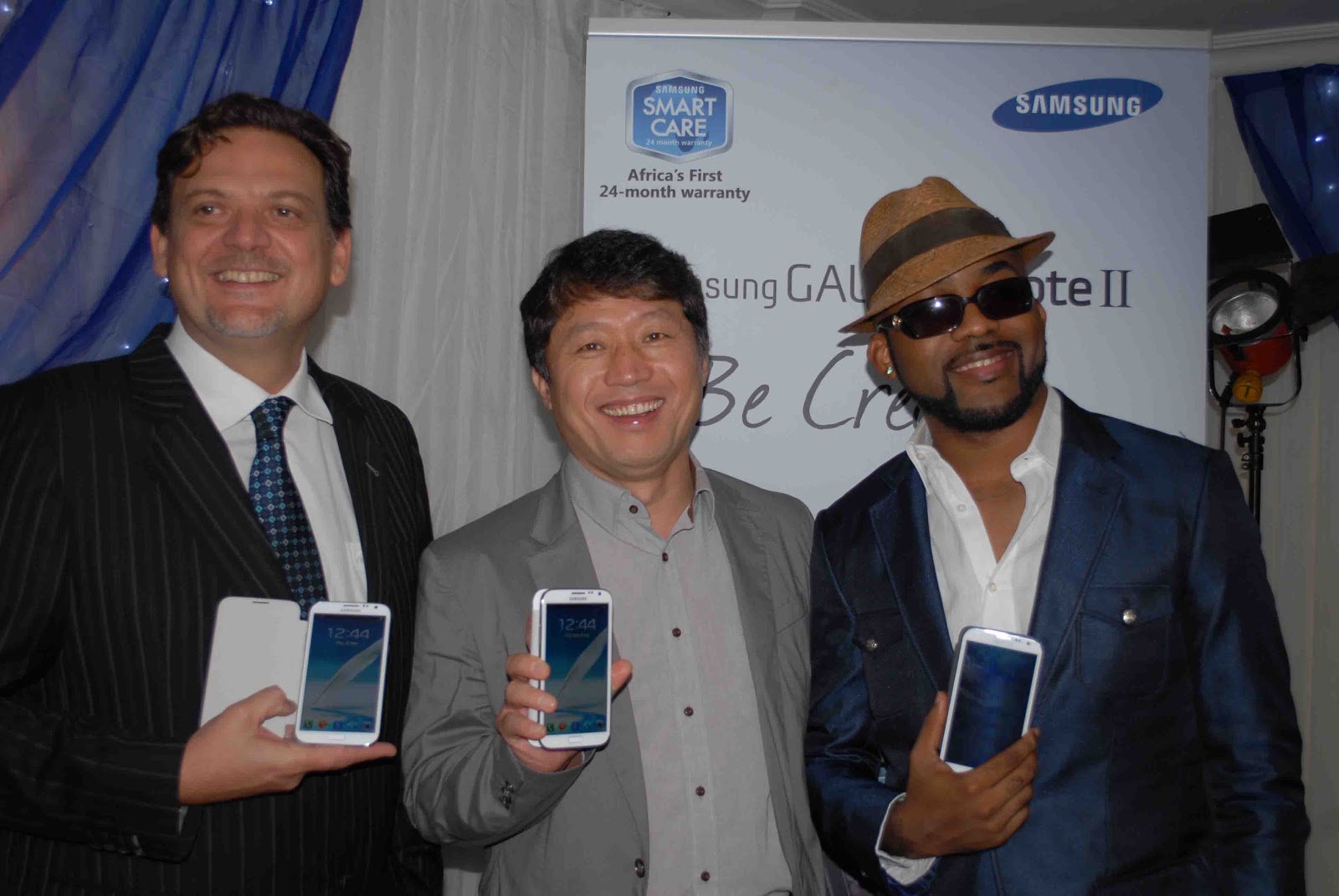
Samsung’s Galaxy Note II Arrives Nigeria


SAMSUNG Electronics’, the world's largest maker of mobile handsets, has rolled out its highly anticipated Galaxy Note II in Nigeria, adding a new Galaxy device to its range of products in this category.
The device, a mix of smartphone and tablet with an improved digital stylus called the S Pen, was unveiled to the Nigerian public in Lagos. The launch of the device in Nigeria is coming on the heels of its initial introduction at the IFA Trade Show in Berlin and its subsequent arrival on the African continent at a colourful unboxing event in Cape Town, South Africa, in October.
 According to the Managing Director of Samsung Electronics West Africa, Mr. Bravo Kim, the Galaxy Note II will ensure that Samsung maintains its dominance over Apple and other smartphone manufacturers in the global smartphone market, by positioning itself as a niche to meet the demands of consumers desirous of larger screens and more user-friendly display.
"The Galaxy Note II is taking over the fame of its predecessor, the Galaxy Note, which opened a new category of smart mobile devices last year. A great number of innovations were injected into the product towards delivering new value to enhance the lives of our consumers and also provide them with the ultimate communication experience. The device has already gained fame, alongside a solid reputation, among individuals and mobile carriers across the globe and we are very proud of its accomplishments," he said.
Kim reiterated Samsung’s commitment to fulfilling its brand promise of inspiring the world and creating the future through its commitment to bringing new and meaningful innovations to the doorstep of customers.
Powered by the latest version of Google’s Android operating system, Jelly Bean, the Galaxy Note II features a 1.6 GHz quad-core processor and 4G LTE connectivity. Its 5.5-inch HD Super AMOLED display is ideal for users who want the productivity of a tablet with the portability of a smartphone. 
 Its 8 megapixel rear-facing and 1.9 megapixel front-facing camera allows users to share photos through Share Shot, while S Beam lets users share videos, pictures and more with other Galaxy Note II and Galaxy S III devices. The Galaxy Note II is thinner and narrower than the first Galaxy Note, and it improves upon the original with longer battery life, as well as enhancements to the S Pen. It also boasts a microSD slot that allows for expansion by up to an extra 64GB of storage.
 Describing the Samsung Galaxy Note II as the smartphone for on-the-go creativity, Business Head, Hand Held Products at Samsung Electronics West Africa, Mr. Emmanouil Revmatas, reiterated Samsung’s commitment to enhancing and expanding its Galaxy Note product experiences.
 “Since the introduction of the first Galaxy Note, we have continued to enhance and expand this category of product towards delivering the ultimate communication experience to our consumers. In May 2012, we introduced ‘Premium Suite,’ a software upgrade which provides enhanced user experience. Also in August, we expanded the category further with the Galaxy Note 10.1, which has a 10.1-inch large screen, a multiscreen feature and enhanced features for users’ productivity, creativity and learning. The Galaxy Note II represents a whole new innovation for the Galaxy Note category and will help users set free their inner creativity by letting them discover information faster, capture ideas, and express them in a more organized and efficient manner,” he said.
L – R: Business Head, Hand Held Products, Samsung Electronics West Africa, Mr. Emmanouil Revmatas; Managing Director, Samsung Electronics West Africa, Mr. Bravo Kim and Samsung Brand Ambassador, Mr. Olubankole Wellington (Banky W), at the unveiling of Samsung’s Galaxy Note II Smartphone at Westown Hotel in Ikeja, Lagos.
 From its inception as a small export business, Samsung has grown to become one of the world’s leading electronics companies, specializing in digital appliances and media, semiconductors, memory and system integration. Today, Samsung’s innovative and top quality products and processes are recognized all over the world. The company has continued to expand its product lines and reach, following its mission of making life better for consumers all over the world.